
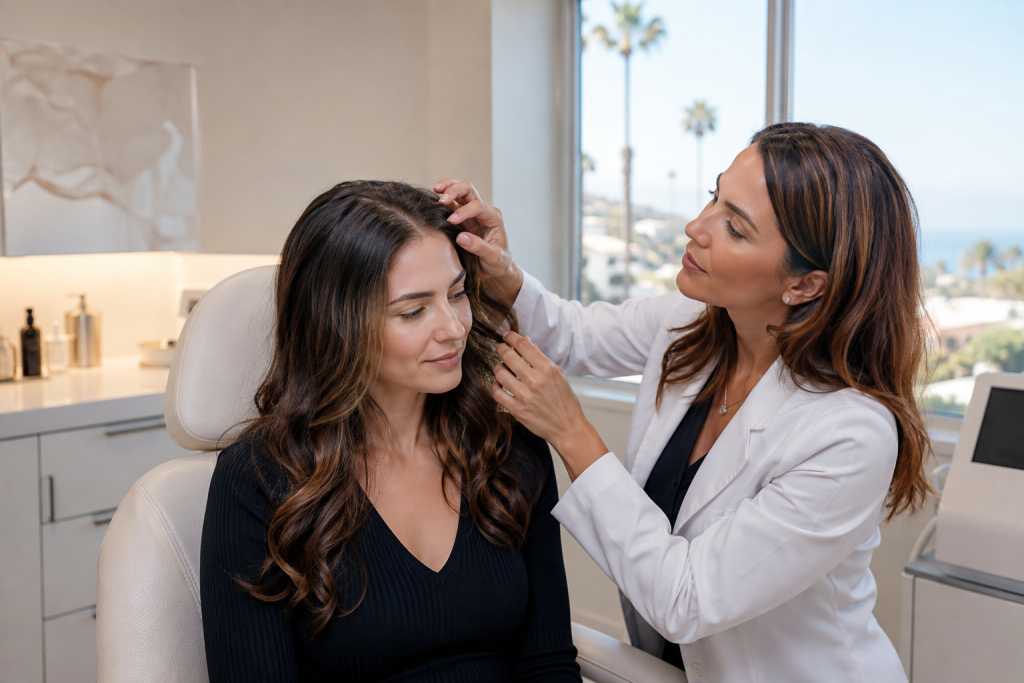
PRP for hair loss uses platelet-rich plasma prepared from a patient’s own blood and injected into areas of the scalp affected by thinning. Research suggests PRP can improve hair density and reduce shedding in some people, particularly those with androgenetic alopecia, although results vary and treatment protocols are not yet fully standardized.
ALCHEMĒ Medical Spa Del Mar
ALCHEMĒ Medical Spa Del Mar offers regenerative treatments and PRP therapy, while its current regenerative-treatment information specifically identifies exosome therapy for hair restoration. The published materials reviewed for this article did not clearly confirm PRP scalp injections as a current Del Mar hair-restoration service, so patients interested specifically in PRP for thinning hair should confirm availability during consultation. ALCHEMĒ currently advertises a free aesthetic consultation plus $50 off for first-time clients, with exclusions applying.
Quick Takeaways
- PRP is made by concentrating platelets from a patient’s own blood and injecting the resulting plasma into the scalp.
- Research is most encouraging for androgenetic alopecia, commonly called male- or female-pattern hair loss.
- PRP generally requires a series of treatments, not a single appointment.
- Results are gradual, and improvement may take several months to become noticeable.
- PRP does not work equally well for every type or stage of hair loss.
- A professional evaluation is important because identifying the cause of hair loss should come before choosing treatment.
What Is PRP for Hair Loss?
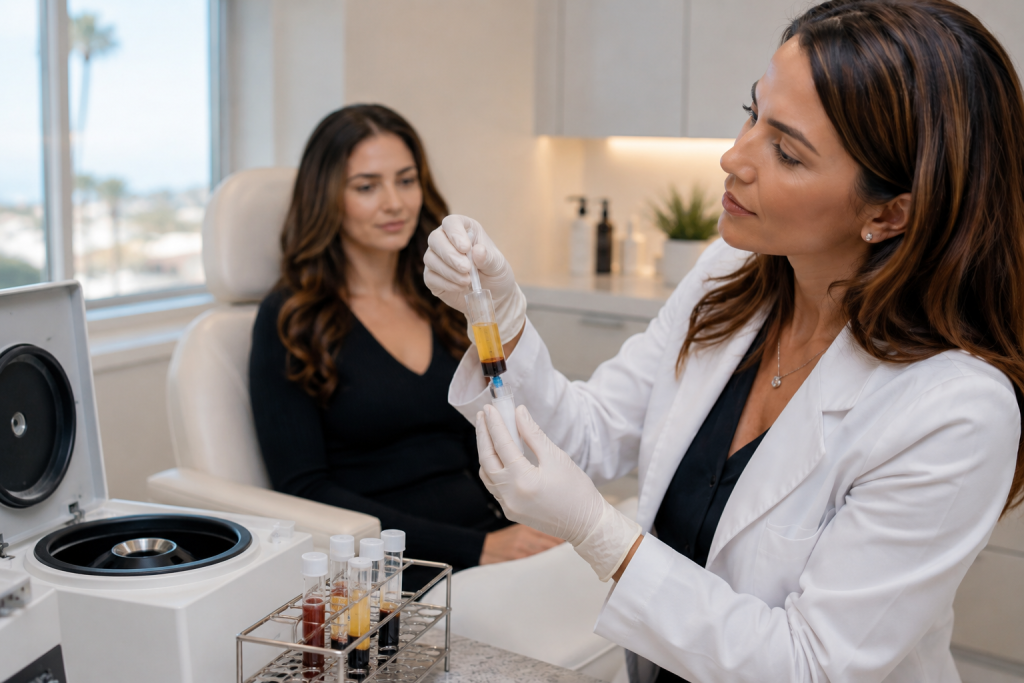
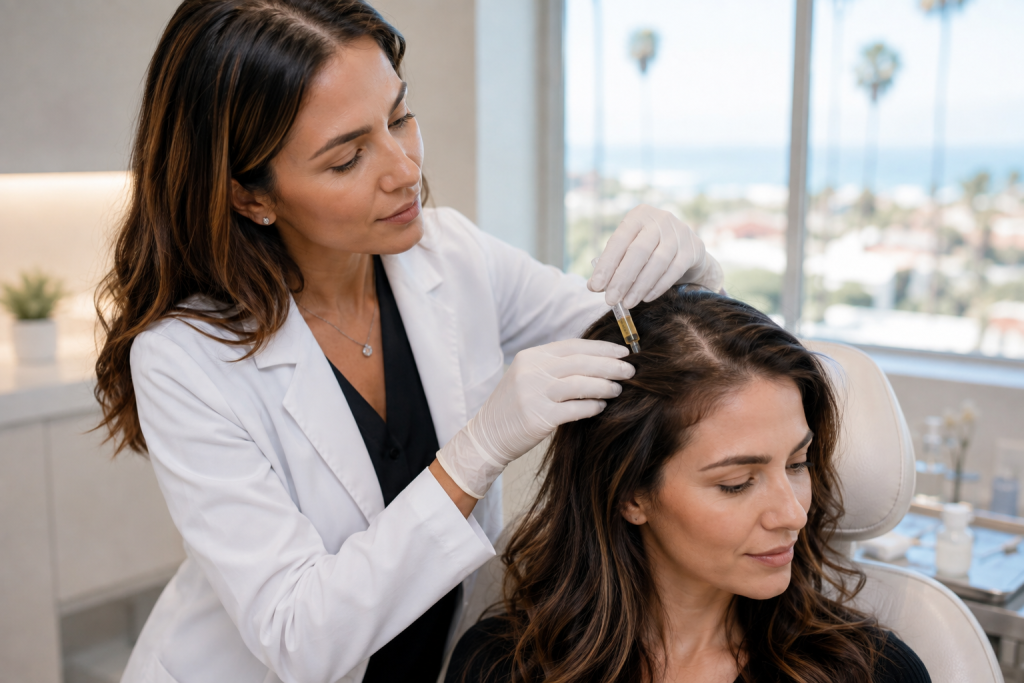
PRP for hair loss is a nonsurgical treatment in which a healthcare professional draws a small amount of blood, processes it to concentrate platelets within the plasma, and injects the prepared PRP into thinning areas of the scalp. Platelets contain growth factors involved in tissue repair and cellular signaling.
The procedure has become an increasingly studied option for androgenetic alopecia. Unlike a hair transplant, PRP does not move follicles from one part of the scalp to another. Instead, treatment is intended to support follicles that are still present.
The American Academy of Dermatology describes PRP as a treatment that studies suggest can be safe and effective for hair loss. It also emphasizes that identifying the type of hair loss matters because different causes require different treatments.
That distinction matters. Gradual genetic thinning, sudden shedding, autoimmune hair loss, nutritional deficiencies, and scarring alopecia are different conditions and should not automatically be approached with the same treatment.
How Does PRP Work for Hair Growth?
PRP is believed to support hair growth by delivering a concentrated source of platelets and growth factors directly around existing hair follicles. These biological components support healing and cellular activity and may help support the growth phase of the hair cycle.
Treatment generally begins with a blood draw. The sample is placed in a centrifuge, which separates its components and produces platelet-rich plasma. A healthcare professional then administers the prepared plasma into selected areas of the scalp.
PRP is an autologous treatment, meaning the material comes from the patient’s own blood rather than from a donor. Cleveland Clinic notes that PRP has applications beyond hair restoration, including other medical and regenerative uses.
Preparation methods, platelet concentrations, and injection protocols can vary by provider. This variation is one reason results differ from study to study.
Does PRP for Hair Loss Actually Work?
Evidence suggests PRP can increase hair density and reduce hair loss for some patients, but it should not be viewed as a guaranteed cure. A 2025 systematic review and meta-analysis of 43 randomized controlled trials involving 1,877 participants found moderate evidence supporting PRP for improving hair density and reducing hair loss, while no significant benefit was demonstrated for hair thickness.
Earlier evidence reaches a similar but more cautious conclusion.
A 2024 systematic review of PRP for male androgenetic alopecia included eight randomized controlled trials and one cohort study. Six studies found a statistically significant improvement in hair density compared with controls, while the authors also highlighted heterogeneity and limitations in the quality of the available evidence.
Another 2024 meta-analysis found an average increase in hair density among people receiving PRP for androgenetic alopecia but described the underlying evidence as low quality because of substantial study heterogeneity and publication bias.
The practical takeaway is straightforward: PRP is promising and supported by clinical evidence, but individual results and treatment protocols vary.
Who Is a Good Candidate for PRP Hair Treatment?
PRP may be most appropriate for people experiencing certain forms of nonscarring hair loss, especially androgenetic alopecia, when viable follicles remain in thinning areas. A qualified healthcare professional should first determine the cause of the hair loss rather than assuming PRP is appropriate based only on visible thinning.
Cleveland Clinic notes that PRP is more difficult to use successfully when follicles have been dormant for a long time. It also identifies underlying conditions and certain medications, including blood thinners, as factors that may affect candidacy or results.
A consultation is particularly important if hair loss is:
- sudden or rapidly worsening
- occurring in distinct patches
- accompanied by scalp irritation or inflammation
- associated with a recent illness or major physical stress
- potentially connected with medications or nutritional deficiencies
- associated with possible hormonal or medical conditions
The goal is not simply to decide whether PRP sounds appealing. It is to identify the cause and then determine which treatment has the strongest rationale for that particular patient.
What Happens During a PRP Hair Treatment?
A typical PRP appointment involves three main stages: collecting blood, separating and concentrating the platelet-rich portion, and administering the PRP to the treatment area. The exact technique and appointment length vary by provider and protocol.
| Stage | What Typically Happens |
|---|---|
| Evaluation | The provider reviews hair loss, medical history and treatment goals. |
| Blood collection | A small blood sample is collected. |
| Centrifugation | The sample is processed to separate and concentrate platelet-rich plasma. |
| Scalp treatment | PRP is administered into selected thinning areas. |
| Follow-up | Additional sessions and progress evaluations may be scheduled. |
The American Academy of Dermatology states that the scalp-injection portion can take about 10 minutes and describes PRP as generally requiring repeated treatments rather than one appointment.
Specific preparation instructions should always come from the treating provider because medical history and medications can affect recommendations.
How Many PRP Sessions Are Usually Needed for Hair Loss?
PRP hair restoration generally requires an initial treatment series followed by maintenance rather than a single injection session. The American Academy of Dermatology describes a common approach of monthly treatments for the first three months, followed by treatments about every three to six months.
Treat that schedule as an example rather than a universal prescription.
Clinical protocols vary because no single standardized PRP preparation or treatment schedule is used across every practice or research study. An older systematic review of androgenetic alopecia research found that most included studies used at least three treatments separated by several weeks.
Your recommended schedule may depend on:
- the cause and severity of thinning
- how long hair loss has been occurring
- response to the initial sessions
- whether other therapies are being used
- the provider’s PRP preparation protocol
Consistency matters because hair growth happens gradually through a biological cycle, not immediately after treatment.
When Can You Expect to See PRP Hair Results?

PRP results generally develop over several months, not days or weeks. The American Academy of Dermatology notes that PRP can begin reducing hair loss within a few months, after which some patients notice thickening or regrowth.
Patients should therefore evaluate progress over an appropriate timeline instead of expecting an immediate cosmetic transformation.
Providers may monitor changes through standardized photographs, assessment of shedding, hair density or other clinical measures. Because individual responses differ, before-and-after comparisons should ideally use similar lighting, angles and hair positioning.
It is also important to separate reduced shedding, increased density and increased hair thickness. These are different outcomes. The 2025 meta-analysis found evidence supporting increased density and reduced hair loss but did not find a significant improvement in hair thickness.
PRP vs. Other Hair Loss Treatments: Which Is Better?
No single hair-loss treatment works best for everyone because treatment should match the diagnosis. PRP is a nonsurgical option, while medications, low-level laser therapy, and hair transplantation work through different mechanisms and may be recommended alone or in combination.
| Option | General Approach | Important Consideration |
| PRP | Uses concentrated components from the patient’s blood | Usually requires multiple sessions and maintenance |
| Minoxidil | Medication applied to support hair growth | Requires ongoing use for continued benefit |
| Prescription treatments | May target hormonal causes of pattern hair loss | Eligibility and risks depend on the medication and patient |
| Low-level laser therapy | Uses light to stimulate follicles | Often requires repeated treatments over many months |
| Hair transplant | Surgically relocates existing follicles | More invasive and generally used for appropriate candidates |
| Exosome-based treatment | Regenerative approach offered by some practices | Protocols and evidence differ from PRP |
Cleveland Clinic notes that PRP may also be combined with established hair-loss medications such as minoxidil or finasteride in appropriate patients.
The right choice therefore depends on the diagnosis, treatment goals, medical history, degree of hair loss, budget, and willingness to maintain therapy.
What Are the Possible Side Effects of PRP?
Because PRP is prepared from the patient’s own blood, it avoids some concerns associated with donor-derived materials, but the injection procedure can still cause temporary effects. Reported reactions include scalp discomfort, redness, pinpoint bleeding, and tenderness around injection sites.
More significant complications are less common but should still be discussed with a qualified healthcare provider before treatment.
Patients should tell their provider about medications, supplements, bleeding disorders, and relevant medical conditions before undergoing PRP. Following the provider’s preparation and aftercare instructions can also help reduce avoidable complications.
What Hair Restoration Options Does ALCHEMĒ Medical Spa Del Mar Offer?
ALCHEMĒ’s published regenerative-treatment information currently identifies exosome therapy specifically for hair restoration. The practice also provides PRP and PRF regenerative injections, but its current service description discusses those injections in relation to joints, ligaments, and tendons rather than explicitly identifying PRP scalp injections as a hair-loss service.
For that reason, patients should not assume PRP hair treatment is currently available without asking the practice directly.
ALCHEMĒ Medical Spa Del Mar is located at 12895 Paseo Village Way, Suite 1240, San Diego, CA 92130. The business’s official website currently lists a free aesthetic consultation and $50 off for first-time clients, with exclusions applying.
For patients researching hair restoration in Del Mar, a consultation provides an opportunity to discuss the cause of thinning, available regenerative options, and whether PRP, exosome therapy, or referral to another hair-loss specialist is appropriate.
Frequently Asked Questions
Is PRP for hair loss permanent?
PRP should not generally be considered a permanent cure for progressive hair loss. The American Academy of Dermatology describes maintenance injections every three to six months after an initial treatment series, indicating that ongoing treatment may be recommended to maintain improvement. The underlying cause of hair loss also influences whether thinning continues over time.
Does PRP regrow completely bald areas?
PRP is generally more promising when follicles remain viable rather than in areas where follicles have been inactive or permanently destroyed for a long time. Cleveland Clinic notes that long-standing dormant follicles are harder to stimulate. Scarring alopecia can permanently destroy follicles, making proper diagnosis especially important.
Is PRP better for men or women?
PRP is used for hair loss in both men and women, although individual response depends more on the type and stage of hair loss than sex alone. Much of the published research has focused on androgenetic alopecia. A professional diagnosis helps determine whether PRP or another treatment is more appropriate.
Can PRP be combined with other hair-loss treatments?
Yes. PRP may be incorporated into a broader hair-restoration strategy for appropriate patients. Cleveland Clinic notes that combining PRP with medications such as minoxidil and finasteride may be effective for some people with pattern hair loss. Select treatment combinations based on diagnosis, medical history, and individual risk factors.
Does PRP require downtime?
PRP is generally considered minimally invasive and usually involves limited downtime. The American Academy of Dermatology states that PRP hair treatment generally does not require downtime, although temporary discomfort or scalp reactions can occur after injections. Patients should follow their provider’s individualized aftercare recommendations.
How much does PRP for hair loss cost?
PRP pricing can vary based on the treatment plan, number of sessions needed, and provider recommendations. ALCHEMĒ Medical Spa Del Mar does not currently publish a specific price for PRP hair-loss treatment on its website. However, new clients can currently receive a free aesthetic consultation plus $50 off their first treatment, with exclusions applying. A consultation can clarify available hair-restoration options, recommended treatment frequency, and personalized pricing before you move forward.
Explore Hair Restoration Options at ALCHEMĒ Medical Spa Del Mar
If thinning hair is affecting your confidence, the first step is understanding what is causing it and which treatments realistically match your needs. While ALCHEMĒ’s current published information does not clearly confirm PRP for hair loss as a Del Mar service, the practice does specifically list exosome therapy for hair restoration and offers personalized consultations for aesthetic and wellness concerns.
If you’re ready to experience personalized, science-backed beauty and wellness, visit Alcheme MedSpa Del Mar location for your first treatment. Be sure to bring your coupon to show the receptionist and enjoy your introductory savings, whether you choose 20 percent off your first visit, 75 dollars off your first service, or 20 percent off NAD therapy. It’s the perfect time to start feeling and looking your best.